
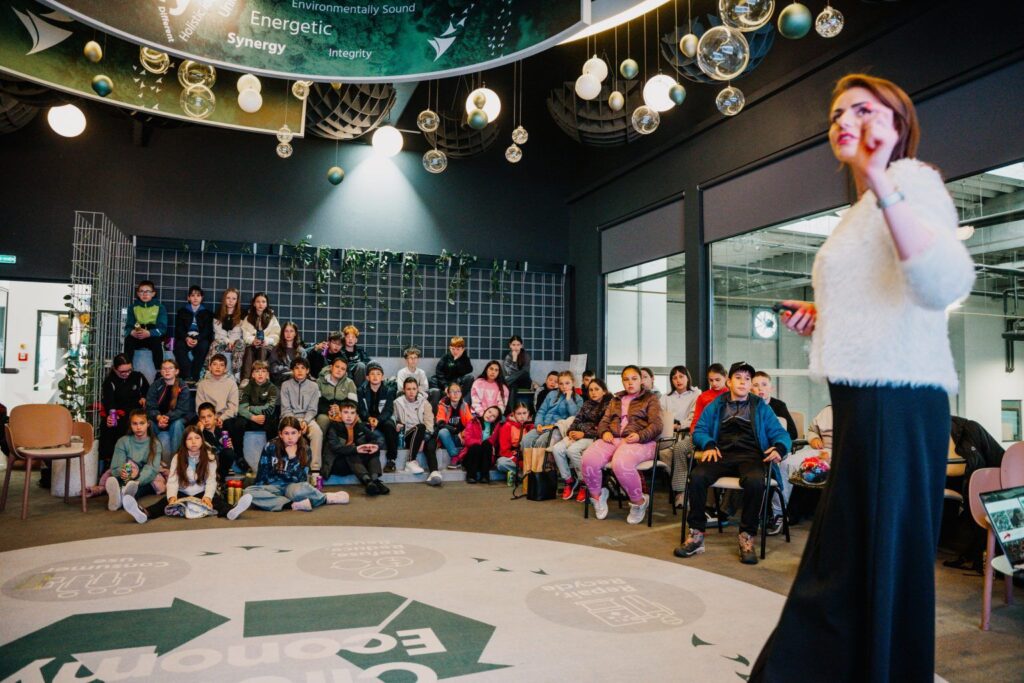
As part of our Green Calendar program, we had the opportunity to take part in a valuable study visit in April, during which we visited, among other places, the GreenGroup facilities in Buzău. The program, organized for the most outstanding students of the Ciuc Basin, provided an excellent opportunity to gain a closer understanding of an important aspect of waste management.
But how does GreenGroup relate to our everyday lives? Let us begin with a brief introduction to waste management.
During Hangyasuli’s environmental education programs, we frequently discuss waste management, focusing primarily on how each of us can become more environmentally conscious through a few simple actions in our daily lives. These activities can be divided into three main categories:
Prevention. From an environmental perspective, this is the most important step. By paying attention to what we buy, how much we buy, and the type of packaging we choose, we can significantly influence the amount of waste we generate. This is why many of our educational programs emphasize the importance of conscious and responsible consumption.
Selective collection. The second step is ensuring that packaging materials and other items accumulated in our households are delivered to the appropriate collection points. Although considerable progress has been made in recent years, many people still face challenges when trying to determine how to dispose of certain types of waste in an environmentally responsible way.
Disposal. The final stage is disposal, which in our region mainly means landfilling. Our goal should be to ensure that as little waste as possible reaches this stage. In the past, we closely followed the public meetings and developments related to the establishment of the regional waste management facility. We know that hosting a landfill is not an easy decision for any community. At the same time, we must acknowledge that if we generate waste, it has to be managed and stored somewhere. The days of using unlined gravel pits and improvised dumping sites are long gone. This is why it is so important to extend the lifespan of modern waste management facilities that have required enormous investments to build.
The full report is available in Hungarian here.


